I looked at 37,622 Show HN posts. 73% got no comment from anyone else
· 6 min read
I collected every Show HN post from January to September 2026 and counted how the posts that got comments differed from the ones that did not. The conclusion comes first, then how I got there.
What the posts that got replies had in common
- The link pointed to the author's own domain or to GitHub. Posts that linked straight to an app store or GitLab, and text-only posts with no link, did worse.
- The post had more than 500 characters of text: why the author built it, and how it differs from what already exists.
- The title had a number and a first-person word, like "I built", "my", "3 years" or "10x".
- The author replied to other people within the first hour.
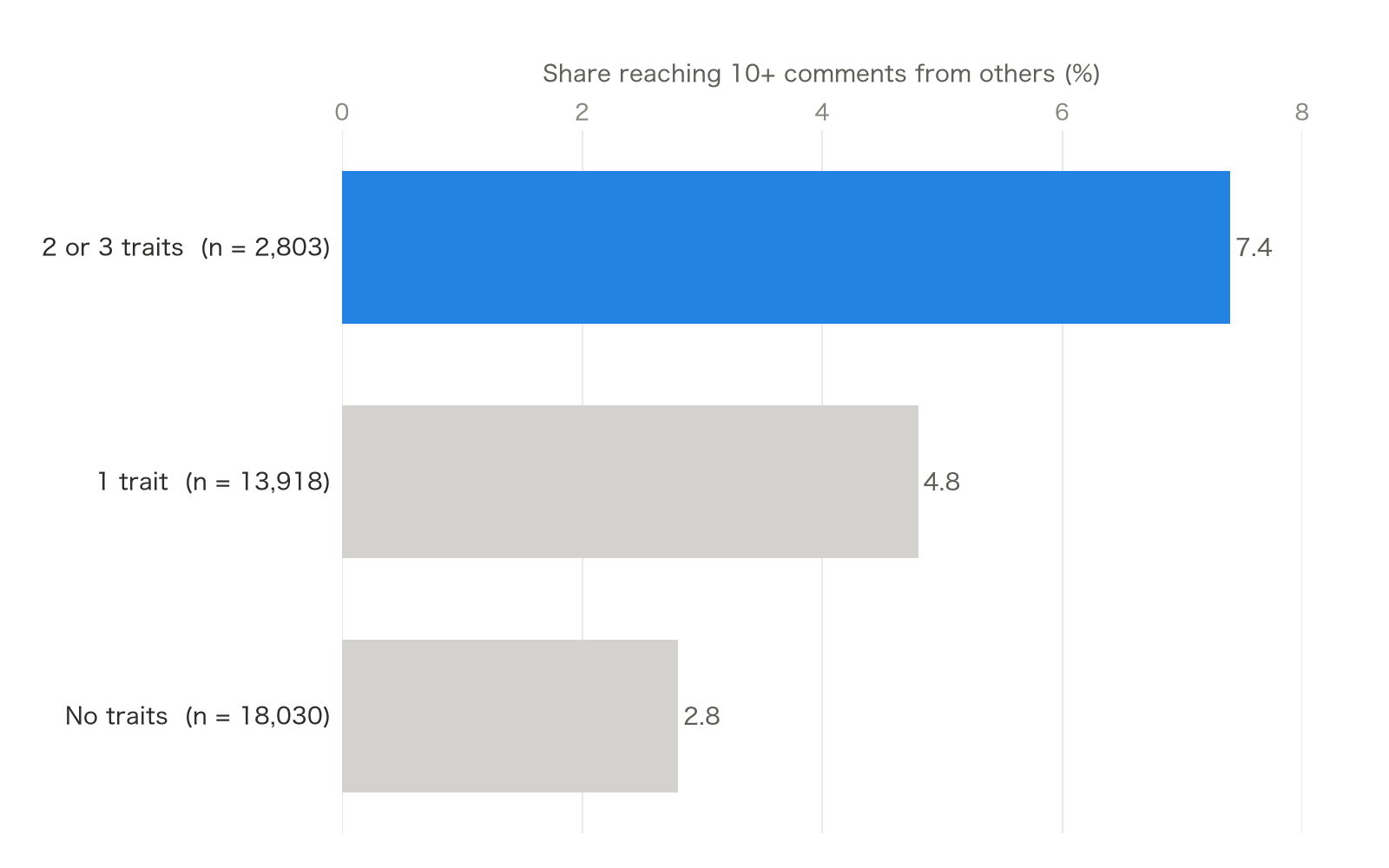
Correlation, not causation, but all four are things you control. Here is how far apart the posts were (Figure 1 and Table 1). Table 1 only includes posts that linked to their own domain or to GitHub, and counts how many of three traits each post had: more than 500 characters of text, a number in the title, and a first-person title.
| Traits met | Posts (n) | 10+ comments from others (%) | 1+ comment from others (%) |
|---|---|---|---|
| None of: 500+ characters of text, a number in the title, first person | 18,030 | 2.8 | 23.3 |
| One of them | 13,918 | 4.8 | 29.8 |
| Two or more | 2,803 | 7.4 | 36.2 |
The chance of reaching 10 or more comments from other people goes from about 1 in 36 to about 1 in 14, or 2.6 times. For at least one comment, it goes from about 1 in 4 to about 1 in 3.
The first hour shows the same gap. Among posts that got a comment from someone else within 60 minutes, those that met two or more of the conditions above and whose author replied within that hour reached 10 or more comments 22.8% of the time. Posts that met none of the conditions and got no reply from the author reached it 11.3% of the time. That is again about twice as often.
On the other hand, the usual advice about the day of the week, the time of day, the length of the title, and words like "open source", "free" or "demo" in the title made no difference I could find.
To be honest about the size of this: even posts that had all of these reached 10 or more comments only about 1 time in 14. Show HN is a place where 73% of posts get no comment from anyone other than the author. These four things went with better odds. They do not promise a good launch. The rest of this post breaks the result down one piece at a time.
First, what "zero comments" really means
The comment count shown in the HN listing includes comments written by the author. On Show HN it is normal for the author to post a comment right away explaining why they built the thing, so the listed number looks better than what actually happened.
So I recounted using only comments written by someone other than the author (Table 2).
| How comments are counted | Posts with zero comments (%) |
|---|---|
| Comment count shown on HN | 61.9 |
| Comments from people other than the author | 72.9 |
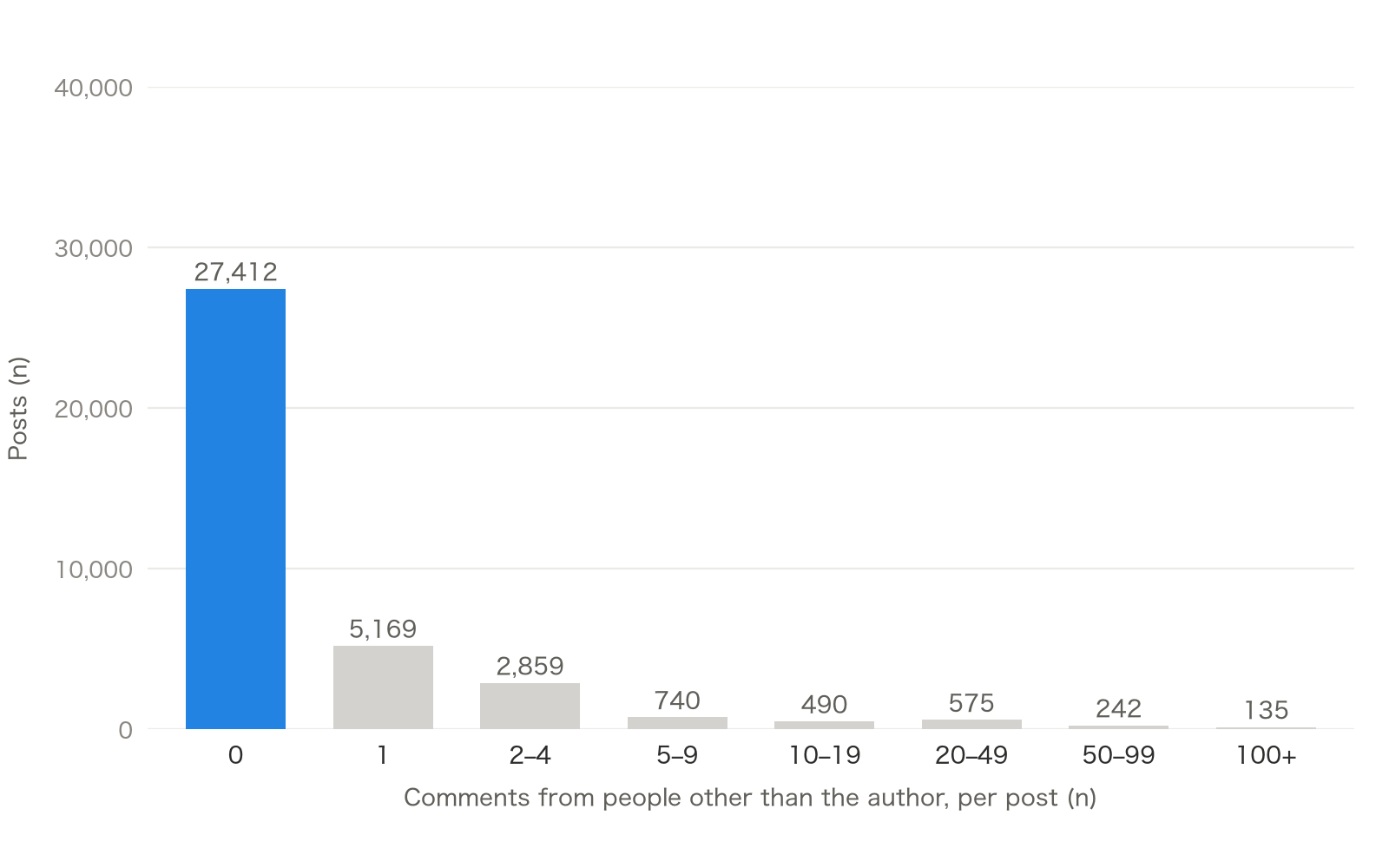
The 11-point gap is posts where the author wrote one comment and nobody else responded. Every number from here on counts only comments from people other than the author. Table 3 and Figure 2 show how those comments are spread across posts.
| Comments from others (n) | Share of posts (%) |
|---|---|
| 0 | 72.9 |
| 1 | 13.7 |
| 2 to 9 | 9.6 |
| 10 or more | 3.8 |
Part 1: where the link points
| Link | Posts (n) | 10+ comments (%) | 1+ comment (%) |
|---|---|---|---|
| Own domain | 20,964 | 4.0 | 28.9 |
| GitHub | 13,787 | 4.0 | 23.9 |
| No link (text only) | 2,037 | 2.4 | 33.6 |
| App stores, GitLab, Hugging Face and similar | 834 | 1.2 | 20.4 |
Your own domain and GitHub came out the same at the 10-comment mark (Table 4). The idea that you need to put your project on GitHub to be taken seriously did not hold up here.
Text-only posts had a high rate of getting at least one comment but a low rate of reaching 10. One reading is that the first comment comes, but with nothing to try, the conversation does not grow. Direct links to app stores and similar platforms were low on both counts, and after holding the other features constant their odds ratio was 0.32.
Part 2: how much text the post has
| Post text | Posts (n) | 10+ comments (%) | 1+ comment (%) |
|---|---|---|---|
| None | 17,169 | 2.7 | 23.6 |
| 1 to 500 characters | 6,753 | 3.7 | 26.6 |
| 501 characters or more | 13,700 | 5.3 | 31.8 |
Posts with more than 500 characters of text reached 10 comments about twice as often as posts with none (Table 5). In a regression with all 15 features at once, this was the largest difference that remained (odds ratio 2.17). Of the four things, this one had the biggest effect.
Close to half of Show HN posts are a link and nothing else. Posts where the author wrote why they built it and what makes it different from existing tools clearly got more responses.
Part 3: numbers and first person in the title
| Title | Posts (n) | 10+ comments (%) | 1+ comment (%) |
|---|---|---|---|
| No number | 31,486 | 3.6 | 26.5 |
| Has a number | 6,136 | 5.2 | 30.5 |
| No first person | 35,046 | 3.8 | 26.5 |
| First person (I built / I made / my / we built) | 2,576 | 4.9 | 36.4 |
Table 6 shows the rates. The odds ratio was 1.49 for a number and 1.34 for first person. First person mattered most for getting the first comment: the rate of getting at least one comment was 10 points higher.
The length of the title made no difference, whether it was under 40 characters or close to the 80-character limit. Neither did "open source", "free", "demo", "no signup" or "try it". What went with more replies in the title was not a choice of words but a number and a person behind the project.
Part 4: replying in the first hour
Here I compared only posts that got a comment from someone else within 60 minutes of posting, 4,564 posts in total (Table 7).
| Author replied to someone within 60 minutes | Posts (n) | 10+ comments (%) |
|---|---|---|
| Yes | 1,670 | 19.9 |
| No | 2,894 | 12.3 |
The odds ratio was 1.53. This one includes a reverse effect: when a thread takes off, the author naturally wants to reply more. Even so, I found nothing that argues for posting and walking away over staying to answer. If you want more on how to talk with people on HN once they show up, see how to find early users on Hacker News.
What made no difference: day and time
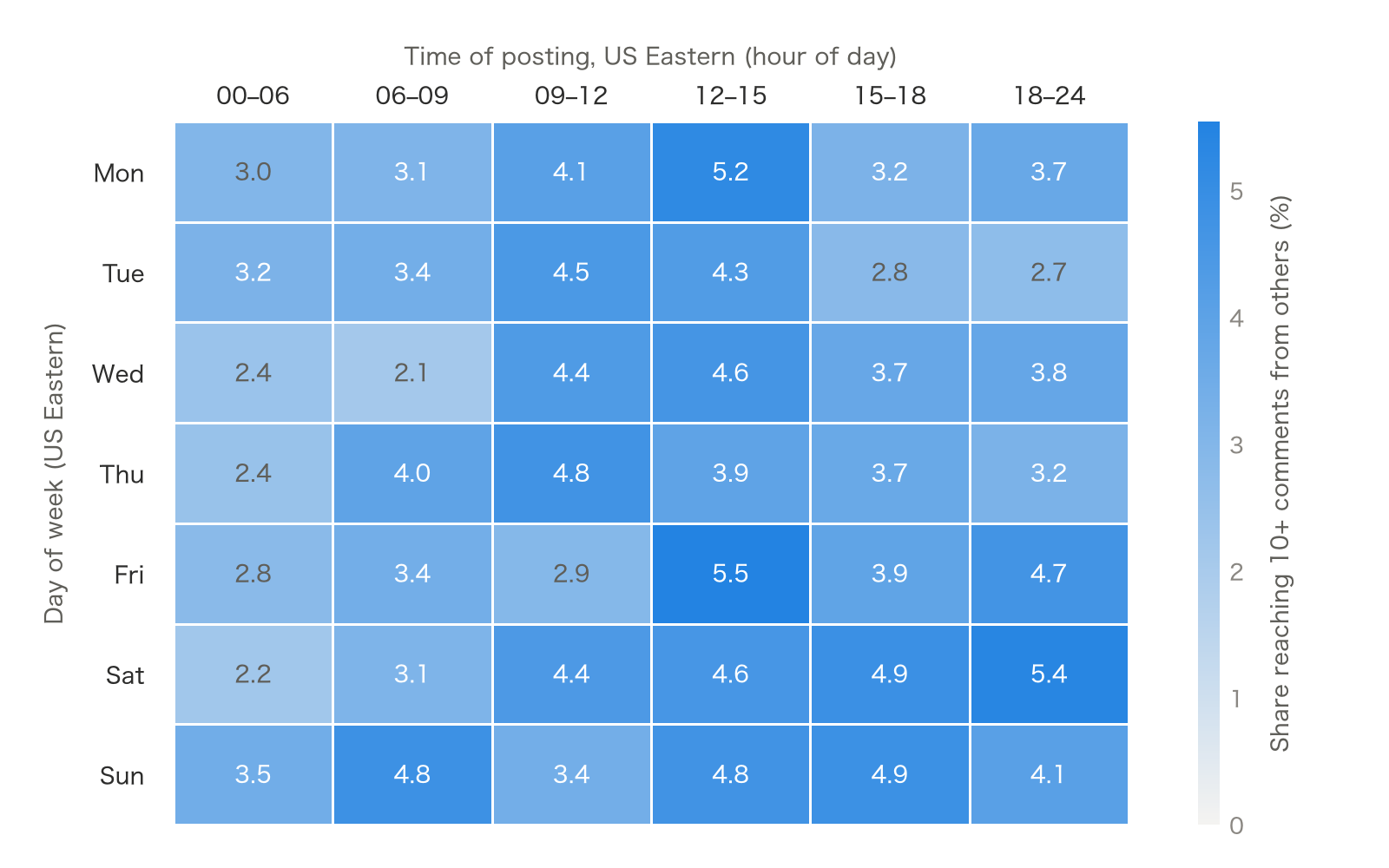
I split posts into the seven days of the week and six time slots in US Eastern time (Figure 3). No day and no time slot showed a difference in reaching 10 or more comments that passed the replication check described below. Advice like "post on Tuesday at 9 a.m." is not supported by these nine months of data.
A note on March
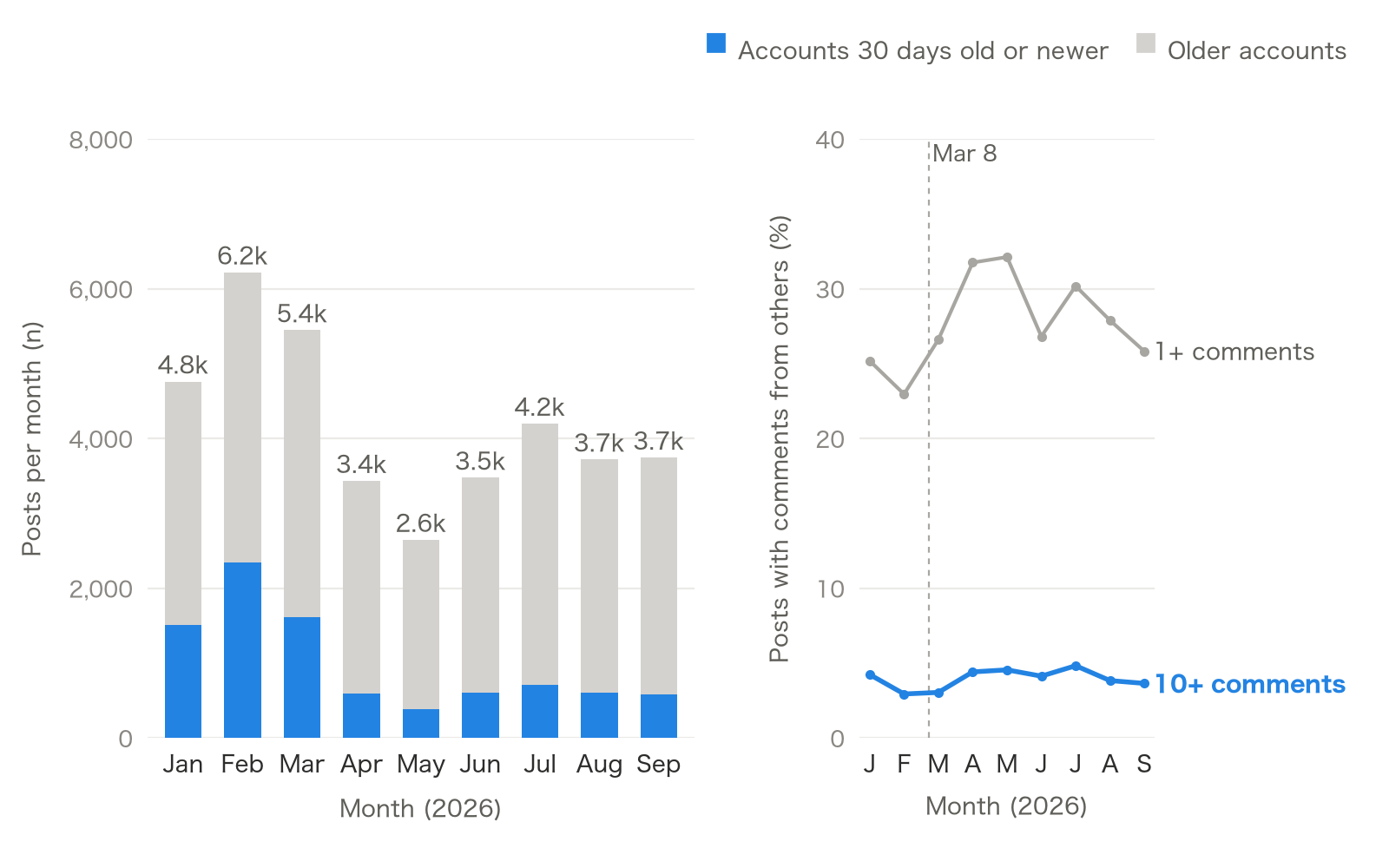
HN started restricting posts from new accounts around March 8, 2026. Table 8 shows how things looked before and after that date, and Figure 4 shows the same by month.
| Measure | Before March 8 | From March 8 |
|---|---|---|
| Posts per day (n) | 195 | 120 |
| Share from accounts 30 days old or newer (%) | 36.0 | 17.4 |
| Share with 10+ comments from others (%) | 3.2 | 4.2 |
| Share with 1+ comment from others (%) | 23.8 | 28.9 |
Posts per day fell by about 40%, the share from new accounts halved, and the rate of getting comments went up. This is only a before-and-after comparison, so I cannot say the restriction caused the change.
Method
- Data: every story tagged show_hn in Algolia's HN Search from 2026-01-01 to 2026-09-30 (UTC), 37,622 posts. The comment tree for each post and the author's account details came from the official HN API.
- Comments from others: a comment counts when its author is not the author of the post. Deleted comments with no author are not counted.
- Measures: 10 or more comments from people other than the author (main), and at least one (secondary).
- Features: I fixed 15 features before looking at the data and did not add any afterwards. They cover the title (length, numbers, first person, and words like "open source" or "free"), the link, the length of the post text, the day and time, the author's account, replies in the first hour, and whether the post came before or after March 8.
- Matching: title and text words are matched without regard to case and on word boundaries, so "free" does not match "freedom". HTML is stripped from the post text before counting characters.
- Link: judged by host name without "www.". github.com is GitHub. GitLab, Hugging Face, the Apple and Google app stores, and the Chrome Web Store are grouped as other large platforms. Everything else counts as the author's own domain.
- First-hour reply: the author wrote a reply to someone else's comment within 60 minutes of posting. A top-level comment by the author does not count.
- Analysis: the rate for each feature with a 95% confidence interval, plus a logistic regression with all features included at once.
- Replication: I split the posts in two by whether the post ID was even or odd (18,805 each), fit the same model on both halves, and only kept a feature in the conclusion if both halves showed a difference in the same direction with a 95% interval that did not cross 1. All four things at the top passed this check.
Limits
- Removed posts are not included. Algolia has almost none of the posts that moderators or flags killed, so every rate here is a rate among posts that survived.
- This is correlation, not causation. People who write careful post text may also build careful products. Still, the text, the title and the replies are the parts a reader can actually change, so there is little reason not to do them.
- It covers January to September 2026 only. I have not checked whether the same differences hold in other years.
- I also looked at author karma and account age, but left them out of the conclusion. The karma I could get is today's value, which includes points the author earned from the post itself, so it partly mirrors the outcome.
- In Table 1, only 190 posts met all three conditions, and their rate of reaching 10 comments was the same 7.4% as posts that met two. Because that group is small, Table 1 groups them as "two or more".
- The first-hour comparison only covers posts that already had a comment from someone else within 60 minutes, so it says nothing about posts that got no early attention at all.
Related guides
How to find early users on Hacker News
Find early users on Hacker News without launching: search comments for real problems, reply with honest technical detail, and keep a sustainable pace.
· 7 min read
You're building in public but nobody replies. Here's what to do instead
Building in public with no engagement? Stop waiting for replies. Go to the people who already have your problem, with a reply order and a 7-day plan.
· 7 min read

Ownfeed
A social feed of people who need your product
Find the people who need your product
- X
- Bluesky
- Hacker News




Every option renews automatically until you cancel. The $1 trial switches to $39/month after 1 day unless you cancel first. Prices in USD; tax may be added at checkout.