What makes a Reddit reply get seen? I measured 188 of my own replies
· 10 min read
In August and September 2026, before Ownfeed existed in its current form, I was selling an earlier product of mine and doing the founder thing: replying to people on Reddit who were asking about the problem it solved. Reddit shows you a view count on each of your own comments, so I wrote every number down. This post is what 188 replies taught me about who actually sees a reply, and how many of those people click through. The conclusion comes first.
The short answer
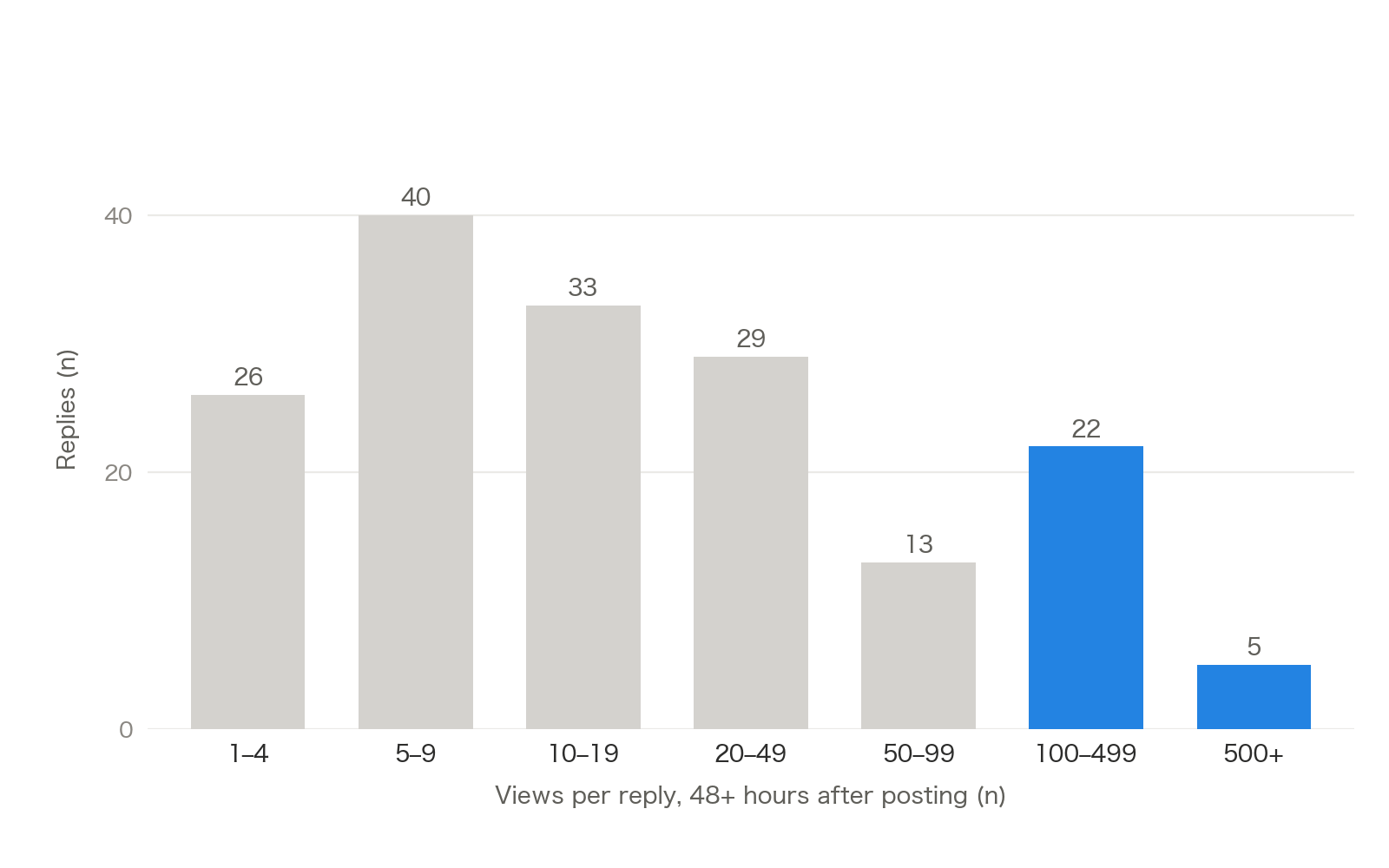
- Most replies are seen by very few people. The typical reply got 14 views, and a handful of replies got most of the attention (Figure 1).
- Which thread you pick matters far more than anything else I could measure. Replies in threads that were already getting comments quickly got about four times the views.
- Reach and conversation pull in different directions. The replies that got the most views were in busy threads where the original poster never answered. The replies the poster answered were in small threads that few others read.
- Views do become visits, but slowly: roughly 2 to 3 visits per 100 views, almost all within a day.
- When you post did not matter. What did matter, as far as I can tell, was the account itself: views per reply dropped by about 40% over two weeks even after accounting for the threads I picked.
All of this comes from one account and one product, with sample sizes in the dozens for most comparisons. Treat it as one founder's measured log, not a law of Reddit. The details and the limits are below.
Most replies get a few views, a few get most of them
I posted 188 replies between August 15 and September 16, 2026, mostly in founder and marketing subreddits such as r/AppBusiness, r/buildinpublic, r/SaaSMarketing and r/GrowthHacking. On September 16 I read the view count of every reply from my profile. 168 of them were at least 48 hours old by then. My own re-reads showed the count barely moves after 48 hours, so those 168 are the fair sample.
Figure 1 shows the shape. The median reply got 14 views, and the middle half of replies landed between 6 and 42. 66 replies, about 4 in 10, got fewer than 10 views. At the other end, 27 replies reached 100 or more and 5 reached 500 or more, and the top 5 replies alone took 43% of all views. The mean was 66, which tells you almost nothing about a typical reply, so I use medians throughout this post.
Upvotes said even less. 141 of the 188 replies stayed at the score of 1 that every comment starts with. Being read and being upvoted are different things, and on most replies nobody pressed anything at all.
Thread speed decided most of the views
For 79 of the replies I had logged the thread's state at the moment I replied: how many comments it had and how old it was. From that I computed a simple speed: comments divided by the thread's age in hours plus one. A thread with 10 comments after 4 hours has a speed of 2.
Speed was the strongest signal in the whole log. The rank correlation between thread speed and views was ρ = 0.53 (95% CI 0.35 to 0.67, n = 79). Replies in threads moving at 1 comment per hour or more had a median of 56 views (n = 38). Replies in slower threads had a median of 13 (n = 41). Table 1 and Figure 2 split the threads into three bands.
| Thread speed (comments per hour) | Replies (n) | Median views (n) | Middle half of replies, views (n) |
|---|---|---|---|
| Slow: under 0.5 | 35 | 9 | 5 to 16.5 |
| Medium: 0.5 to 2 | 21 | 36 | 10 to 106 |
| Fast: 2 or more | 23 | 68 | 21.5 to 137.5 |
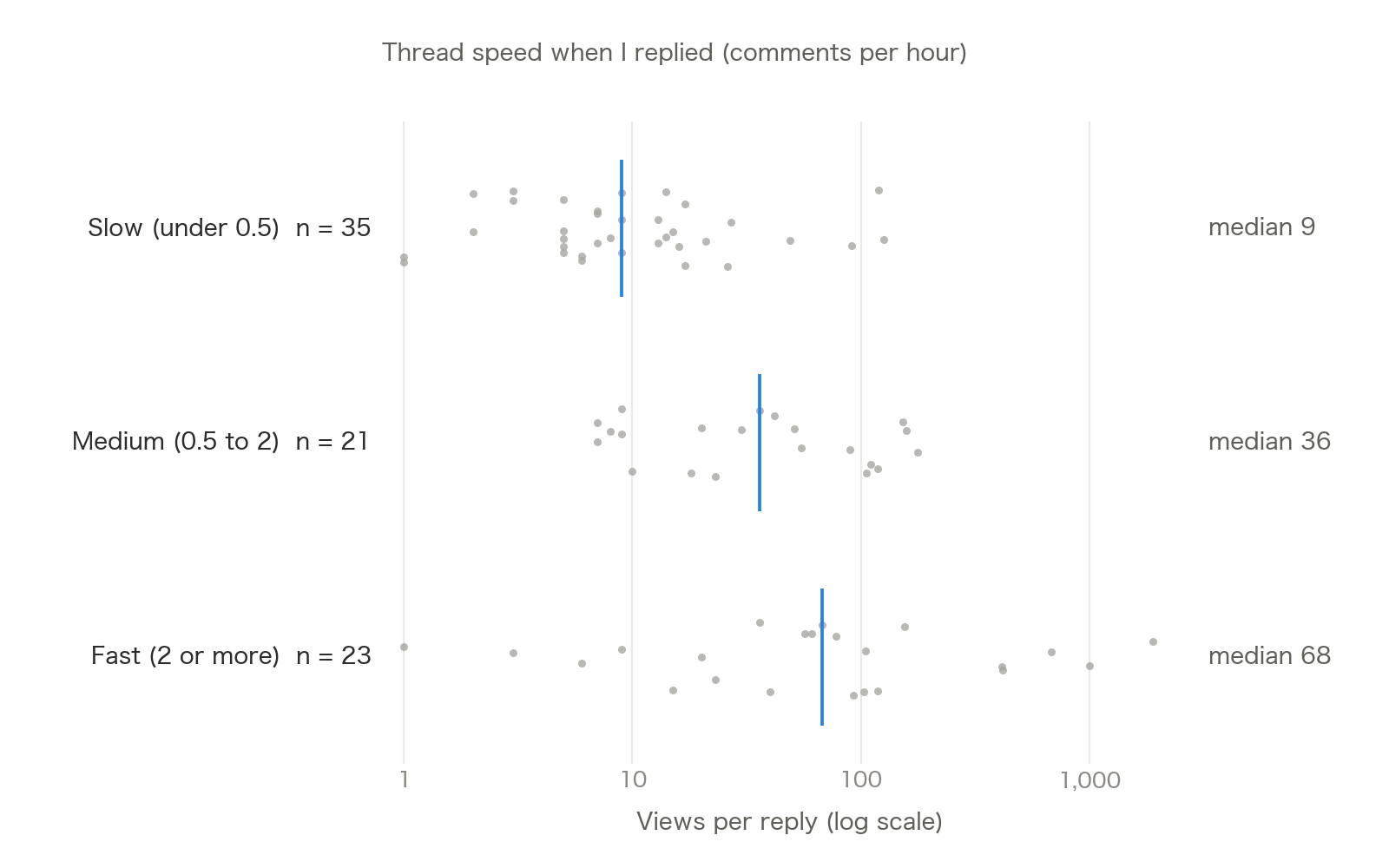
Two cautions. First, the bands overlap a lot. Some fast-thread replies got single-digit views, and two slow-thread replies passed 100. Speed shifts the odds; it does not guarantee anything. Second, the number of comments when I replied correlated almost as strongly (ρ = 0.45), because busy threads are usually fast threads. These are two ways of measuring the same thing, not two separate effects.
Reach or a reply from the author: pick one
From September 5 I ran my replies as two kinds. "Relationship" replies went to threads where the poster was personally stuck on the problem my product solved, regardless of how busy the thread was. "Exposure" replies went to fresh, busy discussion threads, picked to be seen. Both used the same writing style and the same plain link.
In the first two days I sent 7 relationship replies and 8 exposure replies, and tracked whether the thread's author wrote back. Table 2 and Figure 3 show the result.
| Measure | Relationship replies | Exposure replies |
|---|---|---|
| Replies (n) | 7 | 8 |
| Median views at 48 hours (n) | 13 | 67.5 |
| Total views at 48 hours (n) | 189 | 1,382 |
| Thread's author answered (n) | 4 | 0 |
| Median thread speed when I replied (comments per hour) | 0.34 | 3.04 |
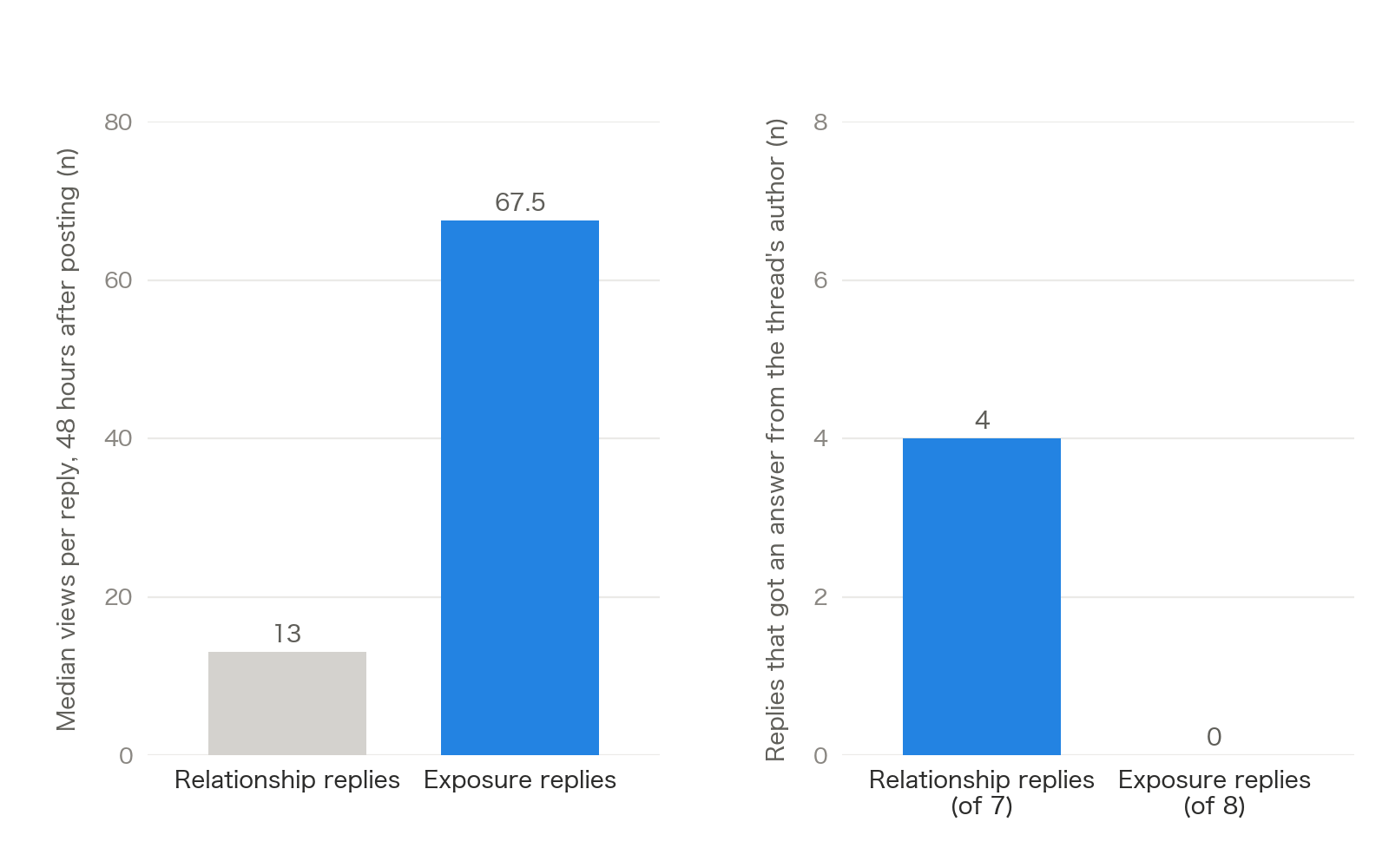
Exposure replies got about 5 times the median views, though with 15 replies that gap could still be chance (Mann-Whitney p = 0.07). The answers went the other way, and that difference is unlikely to be chance even at this size: 4 of 7 against 0 of 8 (Fisher's exact test p = 0.026). All four answers came from posters who were struggling to get customers themselves.
Is the exposure style itself what gets views, or just the threads it picks? Across all 79 logged replies, exposure replies had a median of 57 views against 9, but their threads were also about ten times faster (median speed 2.25 against 0.23). Once thread speed and comment count are in a regression, the gap shrinks from about 6 times to about 2 times, and it is no longer clearly separate from chance (p = 0.10). With a different but reasonable model the gap is about 3 times and clearly real, so I cannot say the style adds nothing. What I can say is that most of the difference comes from where the reply goes, not from how it is written.
How many views turn into visits
Views only matter if some of those people click. I had no tracking parameter on my links, so I matched visits on my own analytics to the batch of linked replies sent just before them. Between August 16 and September 5 there were 14 batches with 1,546 views between them, and 38 visits landed in their windows.
That is 2.46 visits per 100 views, with a 95% confidence interval of 1.69 to 3.23. Figure 4 plots each batch against that rate. The line fits the overall total, but individual batches scatter widely: one batch of 30 views brought 7 visits, while one of 216 views brought 2. Across the 14 batches the rank correlation was only ρ = 0.37 (p = 0.20), so the rate holds for the total, not for any single reply. Timing was tight: 41 of 42 visits came within 24 hours of the batch, with a median of 2.5 hours.
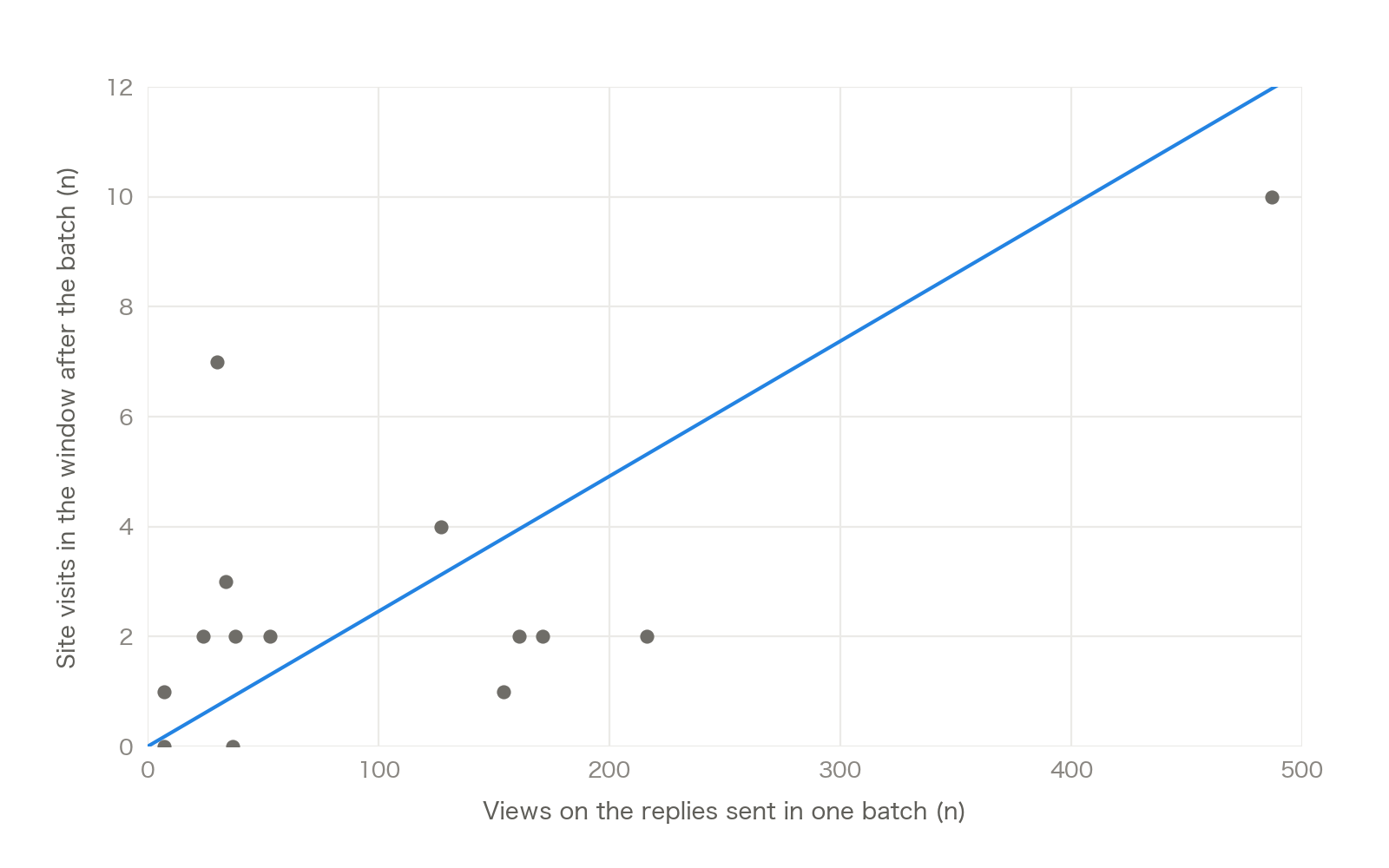
Put that next to the first section and the arithmetic gets sobering. A median reply with 14 views produces about a third of a visit. Even a reply that reaches 500 views brings around a dozen visitors. And visits are not signups: in the same log, the one day with the most signups came from threads where the readers had the problem, not from the day with the most views.
Views per reply fell over time
On September 19 I read the view counts again for 197 replies sent from September 1 onward. Table 3 and Figure 5 break them into periods by the date I posted (Japan time).
| Period | Replies (n) | Median views (n) | Replies with 100+ views (n) | Views vs Sep 4–9 in comparable threads (x) |
|---|---|---|---|---|
| Sep 1–3 | 32 | 11.5 | 4 | 0.72 |
| Sep 4–9 | 85 | 23 | 22 | 1.00 |
| Sep 10–13 | 19 | 11 | 1 | 0.63 |
| Sep 15–17 | 35 | 14 | 0 | 0.62 |
| Sep 18–19 | 26 | 8.5 | 2 | Not measured |
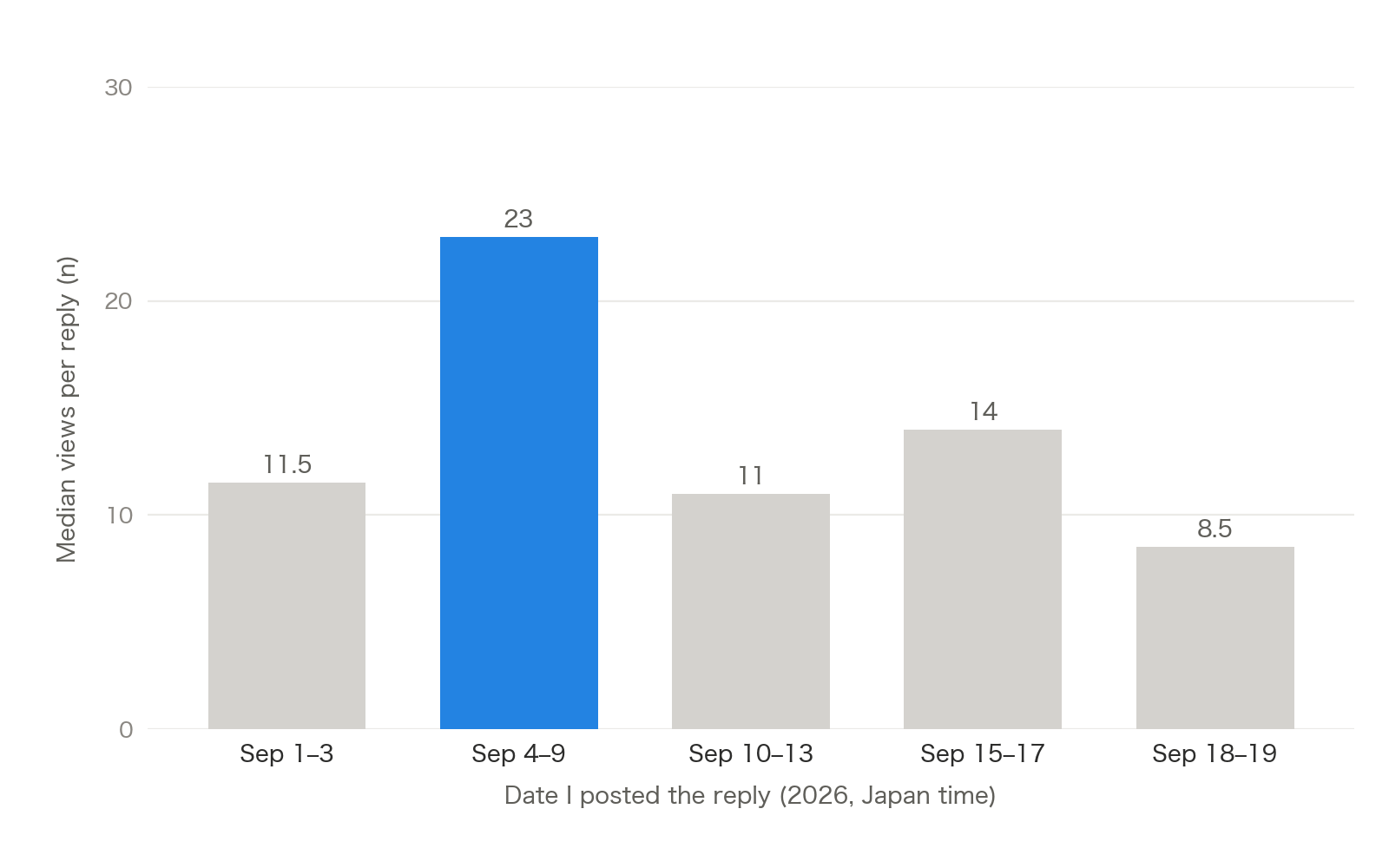
Some of the drop is easy to explain. Early September had a few big hits, and I had stopped replying in two subreddits that had produced many of them. So I compared like with like: replies in the same ten subreddits, in a regression that holds constant the thread's comments before and after my reply, its age and its score (n = 116, R² = 0.62). The last column of Table 3 is the result. Relative to September 4 to 9, comparable replies got 0.63 times the views on September 10 to 13 and 0.62 times on September 15 to 17 (t = −2.1).
The threads did not explain it, and I was sending about as many replies per day (14.2 a day on September 4 to 9, 11.7 on September 15 to 17). What changed was the account. Over the same weeks a few of its replies were downvoted below zero, and on September 17 an automated anti-bot filter on Reddit banned it. My best guess is that the account's standing fell and its replies were shown less, but the data cannot prove that. If you reply often from one account, watch your per-reply median, not your total.
The hour you post did not matter
Advice about the best time to post on Reddit is everywhere, so I checked. Among the 168 replies that were at least 48 hours old, the hour I posted had no relationship with views (ρ = 0.02, p = 0.81). Table 4 shows the medians by time of day. I never posted between 18:00 and 24:00 UTC, so that block is missing.
| Time posted (UTC) | Replies (n) | Median views (n) |
|---|---|---|
| 00:00 to 06:00 | 56 | 15 |
| 06:00 to 12:00 | 39 | 11 |
| 12:00 to 18:00 | 73 | 14 |
A separate check on other people's posts points the same way. Earlier in August I pulled 1,175 posts from eight startup and developer subreddits, including r/SaaS, r/startups and r/indiehackers. 87% of them finished with a score of 1 or less, and the median score was 1 in 23 of the 24 hours of the day. That sample came mostly from three calendar days, so it is weak on its own, but neither source shows a time of day worth planning around. The same goes for Hacker News: in my analysis of 37,622 Show HN posts, day and hour made no difference either.
What I would do with this
- Decide before replying whether you want reach or a conversation. Busy threads get read. Small threads where the poster is stuck get answered. In my log, one reply rarely got both.
- If you want reach, get to threads early, while they are still collecting comments. The same reply in a thread moving at 2 comments per hour got several times the views of one in a thread moving at less than 0.5.
- Budget with the real numbers. At a median of 14 views and about 2.5 visits per 100 views, a single reply is worth a fraction of a visitor. The occasional reply that breaks 100 views carries the total.
- Do not spend effort on the posting hour. Spend it on picking the thread and on writing something the poster will want to answer.
- Watch your per-reply median week by week. A falling median in comparable threads is a sign the account, not the content, has a problem.
For the wider workflow of finding these threads in the first place, see how to find customers on Reddit.
FAQ
How many views does a typical Reddit reply get?
In my log of 168 replies at least 48 hours old, the median was 14 views and the middle half fell between 6 and 42. About 4 in 10 replies got fewer than 10 views, and only 5 passed 500. These were replies in founder and marketing subreddits from one account, so other communities will differ.
Does replying earlier in a thread get more views?
Thread speed mattered more than position. Replies in threads gaining 2 or more comments per hour had a median of 68 views, against 9 in threads gaining under 0.5 per hour. Speed and views had a rank correlation of 0.53 across 79 replies. Thread age by itself showed no clear relationship.
How many Reddit views turn into website visits?
About 2.5 visits per 100 views (95% confidence interval 1.7 to 3.2), measured over 1,546 views on replies with a link. 41 of 42 visits came within 24 hours. Individual replies varied widely around that rate.
Does the time of day I post on Reddit matter?
Not in my data. Across 168 replies the hour of posting had a rank correlation of 0.02 with views. In a separate sample of 1,175 posts from eight subreddits, the median score was 1 in 23 of the 24 hours.
Should I post replies for reach or to start a conversation?
They pulled apart in my test. Replies placed for reach got about 5 times the median views, but the thread's author answered none of 8. Replies to authors who were stuck on the problem got fewer views, and the author answered 4 of 7.
Why did my Reddit replies start getting fewer views?
In my case, views per reply in comparable threads fell to about 0.6 times their early level within two weeks, while the threads and my posting volume stayed similar. A few of its replies had been downvoted below zero and it was later banned by an automated anti-bot filter, which points to the account rather than the content, though the data cannot prove it.
Method
- Replies: 188 Reddit replies I posted from one account between August 15 and September 16, 2026, to promote an earlier product of mine (the predecessor of Ownfeed). View counts were read from my own profile on September 16 at 01:15 UTC. Two counts shown by Reddit as 1K and 1.9K are counted as 1,000 and 1,900.
- 48-hour rule: only the 168 replies at least 48 hours old are used for views. In 79 replies logged both ways, the 24-hour and 48-hour counts matched in 72, and later reads changed little.
- Thread speed: the comment count when I replied divided by the thread's age in hours plus one, taken from my send log. 99 replies had a send log, 79 of them at least 48 hours old.
- Relationship vs exposure: assigned by thread choice before sending, on September 5 and 6. Author answers were checked by hand. The regression for the style question uses log(views + 1) with log-transformed thread speed and comment count. A version without the log transforms is reported in the Exposure section as the alternative model.
- Visits: my own site analytics with bots removed, matched to batches of linked replies by time window (from one send to the next). There was no tracking parameter, so visits are matched per batch, not per reply. The confidence interval is the normal approximation on 38 visits over 1,546 views.
- Decline over time: a second read on September 19 of 197 replies sent from September 1. The comparable-thread regression covers 116 replies in ten subreddits sent September 1 to 17, with thread data pulled from the Arctic Shift archive.
- Posting hour: Spearman correlation of UTC hour and views. The 1,175-post sample was collected from the Arctic Shift archive on August 20, 2026.
- Every number in this post was recomputed from the raw logs for this article. Where my September notes had different figures, I used the raw logs.
Limits
- Small samples. Most comparisons rest on dozens of replies, and the reach vs relationship test on 15. The intervals are wide and a few replies can move a median.
- One person, one account, one product. Everything here came from my account, replying about a tool for founders in a small set of founder and marketing subreddits. Other accounts and other communities may behave differently.
- Correlation, not causation. I picked the threads myself, so the busy threads may also differ in topic or audience in ways I did not measure.
- Reddit's view count is Reddit's own estimate. How it is counted is not published, and the large ones are rounded.
- The account's standing changed during the log, as described in the decline section, so later replies are not directly comparable with earlier ones.
- This was measured in August and September 2026 for a product that has since become Ownfeed. Reddit may have changed since.
- I build Ownfeed, so I have a reason to care about these numbers. I have tried to report the parts that do not flatter the approach as plainly as the parts that do.
Related guides
Does Reddit delete self-promotion? I measured 4,700 comments across 12 subreddits
4,700 comments from 12 startup subreddits: self-promotional ones were removed 23.2% of the time vs 16.0%. A link mattered more than the pitch itself.
· 7 min read
The best tools to find customers on Reddit in 2026, by the job they do
Tools to find customers on Reddit in 2026, sorted by stage: finding posts, filtering them with AI, and drafting replies. Prices, free options and ban risks.
· 10 min read
How to find customers on Reddit for your SaaS (without getting banned)
A step-by-step way to find customers on Reddit: pick the right subreddits, search the way people describe problems, and reply without getting banned.
· 8 min read

Ownfeed
A social feed of people who need your product
Find the people who need your product
- X
- Bluesky
- Hacker News




Every option renews automatically until you cancel. The $1 trial switches to $39/month after 1 day unless you cancel first. Prices in USD; tax may be added at checkout.